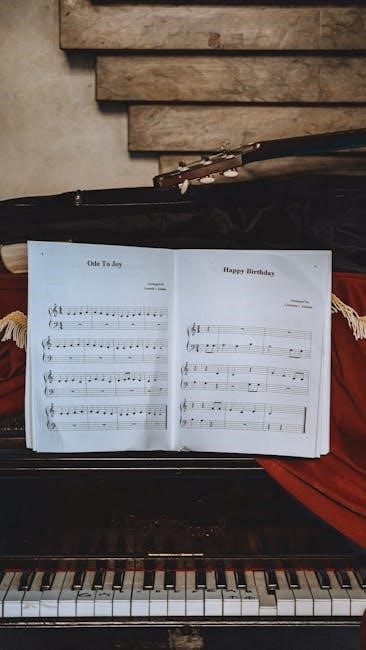
Pachelbel’s Canon in C for Piano: A Comprehensive Guide
Discover readily available Canon in C piano sheet music (PDF) formats online, including free scores from platforms like 8notes.com and paid options for detailed arrangements.
Historical Context of the Canon
Johann Pachelbel’s Canon in D, though often adapted for piano in C, originated around 1680, during the Baroque period. Initially part of a larger set of 24 variations on a theme, the Canon’s enduring popularity wasn’t immediate. It remained relatively obscure for centuries, experiencing a significant revival in the 20th century.
The piece’s structure—a repeating melodic line interwoven with harmonic progressions—became a foundation for countless arrangements, including those specifically tailored for solo piano. The availability of Canon in C piano sheet music (PDF) formats reflects this modern interest. Early printed editions were scarce, but digital distribution has democratized access.
Interestingly, despite Pachelbel’s prolific output, details surrounding the Canon’s original purpose remain somewhat elusive, adding to its mystique. The rise of online marketplaces like OpenSea, while focused on NFTs, indirectly highlights the continued demand for and reimagining of this Baroque masterpiece through digital sheet music.
Johann Pachelbel: Composer Biography
Johann Pachelbel (1653-1706) was a German composer, organist, and teacher of the Baroque period. While celebrated today primarily for the Canon in D, his extensive catalog includes numerous organ works, sonatas, and vocal pieces. He held various musical positions throughout his life, serving as a court organist and Kapellmeister.
Despite his significant contributions, Pachelbel’s fame waned after his death, and he largely disappeared from the Romantic music scene. The rediscovery of his Canon in the 20th century propelled him back into prominence, leading to a surge in demand for his compositions, including piano arrangements.
The widespread availability of Canon in C piano sheet music (PDF) is a testament to his renewed recognition. His influence on later composers is undeniable, and the enduring appeal of his music continues to inspire musicians and audiences alike, facilitated by modern digital access to his scores.
The Original Canon: Instrumentation and Form
Pachelbel’s Canon in D, originally scored for three violins and basso continuo (typically a cello and harpsichord), is a remarkable example of contrapuntal writing. The form is a strict canon, where each violin enters with the same melodic line, staggered in time, creating a layered texture. The basso continuo provides a harmonic foundation based on a repeating chord progression.
The enduring popularity of the Canon has led to countless arrangements for various instruments, including piano. Accessing Canon in C piano sheet music (PDF) allows pianists to explore this iconic piece in a different context. These arrangements often adapt the original instrumentation to the piano’s capabilities, preserving the harmonic structure and melodic interplay.
Understanding the original instrumentation informs interpretations of piano versions, highlighting the composer’s intent and the piece’s inherent beauty.

Finding Canon in C Piano Sheet Music (PDF)
Locate diverse Canon in C piano sheet music (PDF) resources, spanning free online scores and paid repositories, offering varied arrangements for all skill levels.
Free Sheet Music Sources Online
Numerous websites provide access to Canon in C piano sheet music (PDF) at no cost. 8notes.com is a prominent example, offering a readily downloadable version suitable for piano performance. Free Scores – Com also features Pachelbel’s Canon, alongside other compositions by Ferdinando Carulli, presenting a diverse catalog for musicians.
However, it’s crucial to exercise caution when utilizing free resources. The quality of transcriptions can vary significantly, potentially containing errors or incomplete sections. Always compare multiple sources to ensure accuracy. Furthermore, be mindful of copyright restrictions, even with freely available materials. While many public domain scores exist, some arrangements may still be protected.
These online platforms offer a convenient starting point for beginners and those seeking a quick, accessible version of the Canon. Remember to critically evaluate the sheet music before relying on it for serious study or performance.
Paid Sheet Music Options and Repositories
For musicians desiring higher-quality and more accurate Canon in C piano sheet music (PDF), several paid options and repositories exist. While specific platforms weren’t directly mentioned, exploring established sheet music retailers is advisable. These often feature professionally transcribed arrangements, ensuring greater fidelity to the original composition.
Paid sheet music frequently includes detailed fingerings, dynamic markings, and articulation suggestions, beneficial for intermediate to advanced players. Furthermore, purchasing sheet music supports composers and arrangers, fostering continued musical creativity. Consider searching for arrangements specifically tailored to your skill level, as variations exist in complexity.

Investigating online marketplaces like Musicnotes.com or SheetMusicPlus could yield suitable options. These platforms often offer previews, allowing you to assess the arrangement before purchasing. Remember to check licensing terms to ensure the sheet music is suitable for your intended use – personal practice, performance, or teaching.
Understanding Sheet Music Variations
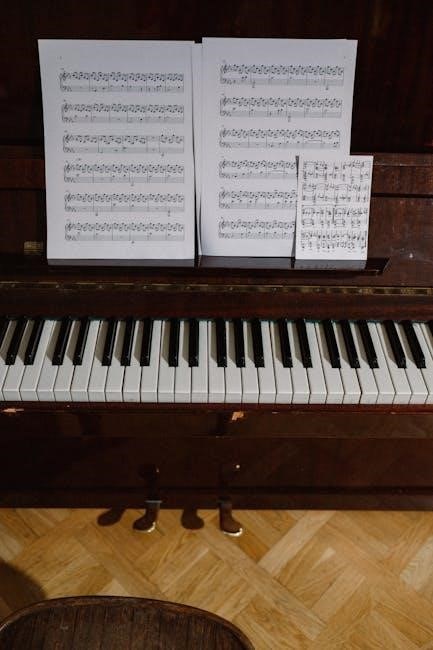
When sourcing Canon in C piano sheet music (PDF), be aware of the numerous variations available. The original Canon is a relatively simple harmonic progression, leading to diverse interpretations for piano. Some arrangements maintain strict adherence to Pachelbel’s original, while others, like George Winston’s, offer significant stylistic departures.
Variations can differ in key signature (though C major is standard), voicing, and added embellishments. Some PDFs may present simplified versions for beginners, omitting complex harmonies or rhythmic figures. Conversely, advanced arrangements might incorporate countermelodies or intricate ornamentation. Examining the composer or arranger’s name is crucial, as it indicates the arrangement’s approach.
Pay attention to the indicated difficulty level. Sheet music labeled for “intermediate” players will likely demand greater technical proficiency than “beginner” versions. Previewing the score, if possible, helps determine if the arrangement aligns with your skill level and musical preferences before committing to a purchase or download.
Analyzing Different Piano Arrangements
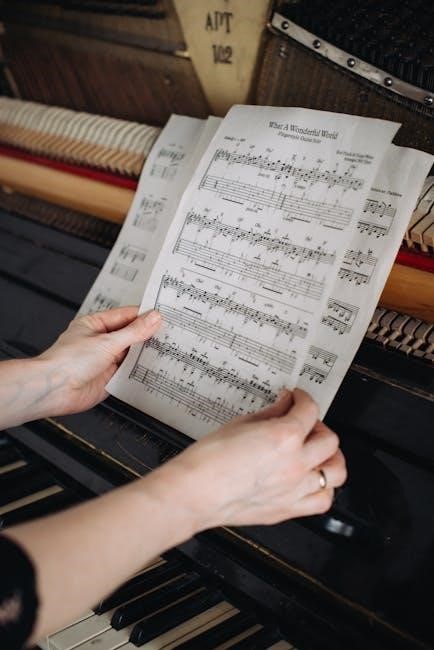
Explore diverse Canon in C piano sheet music (PDF) options, from solo performances to duet interpretations, each presenting unique challenges and artistic expressions for pianists.
Solo Piano Arrangements: Difficulty Levels
Solo piano sheet music (PDF) for Pachelbel’s Canon in C spans a wide range of difficulty, catering to various skill levels. Beginner arrangements often simplify the harmonic structure and rhythmic complexity, focusing on the core melody and basic chord progressions. These versions typically omit ornamentation and advanced pedaling techniques, making them accessible for early-stage pianists.
Intermediate arrangements introduce more intricate voicing, fuller chords, and subtle rhythmic variations. Players at this level will encounter more demanding fingerings and a greater emphasis on dynamic control. The George Winston variation, available as PDF sheet music, represents a more advanced intermediate challenge, requiring a nuanced touch and understanding of his signature style.
Advanced arrangements delve into the full harmonic richness of the Canon, incorporating complex arpeggios, countermelodies, and sophisticated pedaling. These versions demand a high level of technical proficiency and musical interpretation, often requiring years of dedicated practice. Finding appropriate Canon in C piano sheet music (PDF) depends heavily on honest self-assessment of current abilities.
George Winston’s Variation: Style and Technique
George Winston’s Canon in C variation, readily available as piano sheet music (PDF), departs significantly from the original’s Baroque structure. Winston’s interpretation is deeply rooted in his New Age style, characterized by flowing arpeggios, delicate melodies, and a focus on atmospheric textures. The arrangement emphasizes a lyrical and introspective mood, prioritizing emotional expression over strict adherence to the Canon’s formal constraints.
Technically, Winston’s version demands a refined touch and precise control of dynamics. The continuous arpeggios require evenness and clarity, while the melodic lines should sing with warmth and sensitivity. Pedaling is crucial for creating a seamless and resonant soundscape.
Players should focus on achieving a legato touch and avoiding any abruptness in the phrasing. The PDF sheet music often includes detailed fingerings to assist with navigating the complex arpeggiated passages. Mastering this variation requires not only technical skill but also a deep understanding of Winston’s unique musical aesthetic.
Arrangements for Duet/Multiple Pianos
Canon in C piano sheet music (PDF) frequently extends beyond solo performance, offering arrangements tailored for duets or multiple piano ensembles. These versions unlock richer harmonic textures and dynamic possibilities, transforming the familiar Canon into a collaborative experience. Duet arrangements often divide the iconic bassline and harmonic progression between two pianists, creating a fuller sound.
More complex arrangements for three or more pianos may feature layered melodies and counterpoint, expanding upon Pachelbel’s original theme. Finding these PDF scores requires searching specialized music repositories or composer-specific websites.
Successfully performing these arrangements demands precise synchronization and attentive listening between players. Clear part markings and well-edited sheet music are essential for coordinating entrances and maintaining a cohesive interpretation. These collaborative renditions offer a rewarding challenge for pianists of varying skill levels.
Technical Aspects of Playing the Canon
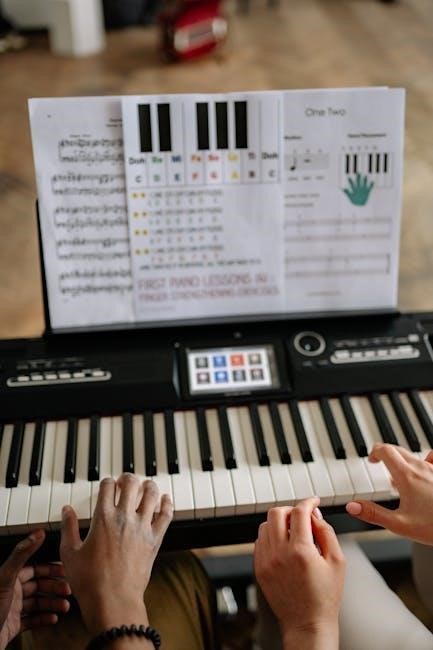
Mastering the Canon in C piano sheet music (PDF) requires understanding its key signature, chord progressions, and addressing common challenges like consistent rhythm and voicing.
Key Signature and Chord Progressions
Pachelbel’s Canon in C is fundamentally rooted in the key of C major, presenting a relatively straightforward harmonic landscape for pianists accessing Canon in C piano sheet music (PDF). The piece predominantly utilizes three chords: C major, G major, and F major, forming a cyclical progression that underpins its mesmerizing quality.
This I-V-IV (one-five-four) progression is repeated throughout the canon, creating a harmonic foundation upon which the melodic lines intertwine. Understanding this simple yet effective chord structure is crucial for interpreting and performing the piece accurately.
The consistent repetition allows for focus on voicing and dynamics. Players should pay attention to smooth transitions between chords, utilizing inversions to maintain melodic flow. Analyzing the piano sheet music (PDF) will reveal how Pachelbel subtly varies the harmonic texture through passing chords and embellishments, adding depth to the otherwise simple progression. Successfully navigating these nuances elevates the performance beyond a mere mechanical rendition.
Common Challenges for Piano Players
Pachelbel’s Canon in C, despite its apparent simplicity, presents unique challenges when approached via Canon in C piano sheet music (PDF). Maintaining consistent tempo and rhythmic precision across all voices is paramount, demanding strong independence of hands. The repetitive nature can lead to complacency, requiring focused attention to articulation and dynamics to avoid monotony.
Beginner pianists may struggle with coordinating the layered textures, as the canon builds upon itself. Accurately interpreting the voicing – bringing out specific melodic lines – is crucial for clarity.
Pedaling requires careful control to avoid muddiness, especially given the sustained chords. Successfully navigating rests, often grouped together in the score, demands precise timing. Studying different arrangements, including George Winston’s variation found in piano sheet music (PDF), can offer insights into overcoming these hurdles and achieving a polished performance.
Pedaling Techniques for Canon in C
Pedaling is critical when interpreting Canon in C piano sheet music (PDF), transforming a potentially static piece into a flowing, resonant experience. The goal is to create a seamless legato without blurring the harmonic clarity. Frequent, subtle pedal changes are generally preferred over long, sustained pedaling.
Beginners often over-pedal, resulting in a muddy sound. Focus on synchronizing pedal changes with harmonic shifts, lifting the pedal slightly before each new chord. Half-pedaling – partially depressing the pedal – offers nuanced control, allowing for subtle sustain without complete harmonic wash.
Analyzing different arrangements, accessible through piano sheet music (PDF) sources, reveals varied pedaling suggestions. Experimentation is key; listen critically to your sound and adjust accordingly. Mastering pedaling enhances the Canon’s ethereal quality and emotional impact.
NFTs and Digital Sheet Music (Recent Trends)
Explore the emerging world of Canon in C piano sheet music (PDF) as NFTs on platforms like OpenSea, revolutionizing digital music ownership and copyright.
OpenSea and the Marketplace for Digital Music
OpenSea, established in 2017 by Devin Finzer and Alex Atallah, has rapidly become a leading online marketplace for non-fungible tokens (NFTs). This platform facilitates the buying, selling, and creation – or “minting” – of diverse NFTs across various blockchain technologies. Increasingly, digital sheet music, including arrangements of Canon in C for piano (PDF), is being tokenized and offered for sale on OpenSea.
This presents a novel opportunity for composers, arrangers, and publishers to directly monetize their work; The blockchain’s inherent security and transparency offer verifiable proof of ownership and authenticity, addressing long-standing copyright concerns within the music industry. Buyers gain unique digital assets, potentially with added benefits like exclusive performance rights or access to related content. The availability of Canon in C piano sheet music (PDF) as an NFT signifies a shift towards decentralized music distribution and a new revenue model for musicians.
The Rise of NFT Sheet Music
The emergence of Non-Fungible Tokens (NFTs) is revolutionizing how sheet music, including popular pieces like Canon in C for piano (PDF) arrangements, is bought and sold. Traditionally, sheet music distribution relied on physical copies or licensed digital downloads. NFTs offer a unique digital ownership experience, verified on the blockchain, providing composers and arrangers with new avenues for revenue and control.
This trend allows for limited-edition releases of arrangements, potentially including unique artistic renderings or performance notes alongside the Canon in C piano sheet music (PDF). Collectors can now own provably rare digital assets, fostering a new market for musical scores. Furthermore, NFTs can embed royalty structures, ensuring creators receive ongoing compensation from secondary sales. The rise of NFT sheet music represents a significant disruption, empowering musicians and offering collectors a novel way to engage with their favorite compositions.
Copyright Considerations for Digital Music
Navigating copyright law is crucial when dealing with digital music, especially Canon in C piano sheet music (PDF). Pachelbel’s original Canon is in the public domain, meaning the basic melody is free to use. However, modern arrangements, transcriptions, and editions are protected by copyright. Downloading unauthorized copies of copyrighted arrangements constitutes infringement, even in PDF format.
When purchasing Canon in C piano sheet music (PDF) as an NFT or through traditional channels, ensure the seller has the necessary rights. NFTs don’t automatically grant copyright; they represent ownership of a token linked to the music. Creators must clearly define usage rights. Understanding licensing terms – whether for personal use, performance, or educational purposes – is vital. Respecting intellectual property rights supports musicians and encourages continued creation of quality arrangements.
Further Learning Resources
Explore online piano tutorials and postgraduate courses to deepen your understanding of the Canon in C and enhance your musical skills.

Online Piano Tutorials for Canon in C
Numerous online platforms offer comprehensive piano tutorials specifically designed for learning Pachelbel’s Canon in C. These resources cater to various skill levels, from beginners taking their first steps with sheet music to advanced pianists seeking refinement. Many tutorials break down the piece into manageable sections, focusing on hand positioning, fingering, and rhythmic accuracy.
YouTube is a treasure trove, hosting countless videos demonstrating different approaches to the Canon. Some instructors provide slow-motion demonstrations, while others offer detailed explanations of the harmonic progressions. Websites dedicated to piano learning, such as Flowkey or Skoove, often include interactive lessons and sheet music synchronization, allowing for real-time feedback.
Furthermore, exploring tutorials that specifically address reading the Canon’s sheet music – whether in standard notation or a simplified PDF version – can significantly accelerate the learning process. Look for lessons that explain common musical symbols and techniques used in the piece, ensuring a solid foundation for successful performance.
Advanced Music Theory Concepts Applied to the Canon
Pachelbel’s Canon in C provides a rich landscape for exploring advanced music theory concepts. The piece is fundamentally built upon a repeating chord progression – I-V-vi-iii-IV-I-ii-V – a common harmonic sequence demonstrating functional harmony. Analyzing this progression reveals its diatonic nature within the key of C major, and its cyclical quality contributes to the Canon’s mesmerizing effect.
The Canon’s structure itself exemplifies contrapuntal techniques, specifically imitation. Each voice enters sequentially, mirroring the initial melody at specific intervals, showcasing the principles of polyphony. Studying the harmonic rhythm – the rate at which chords change – reveals a deliberate pacing that enhances the piece’s emotional impact.
Moreover, understanding the concept of basso continuo, prevalent during Pachelbel’s era, illuminates the foundational role of the bassline in supporting the harmonic structure. Examining the sheet music (PDF or otherwise) through this lens deepens appreciation for the Canon’s compositional ingenuity.
Resources for Continuing Musical Education (Postgraduate Courses)

For pianists seeking advanced training beyond studying Canon in C piano sheet music (PDF), numerous postgraduate courses offer specialized study. Universities globally provide Master’s degrees in Performance, Musicology, and Composition, fostering deeper musical understanding.
Institutions like Nossa Pós in Brazil offer online postgraduate programs in Engineering, Industry, and Logistics, potentially beneficial for musicians seeking broader skillsets. UniFCV also presents 25 new distance learning postgraduate courses in Engineering, ranging from four to twelve months, enhancing career prospects.
These programs often cover advanced harmony, counterpoint, and performance practice, building upon foundational knowledge. Furthering education can also improve competitive advantage in job markets and potentially contribute to higher scores on competitive exams. Dedicated study unlocks nuanced interpretations of pieces like Pachelbel’s Canon.